
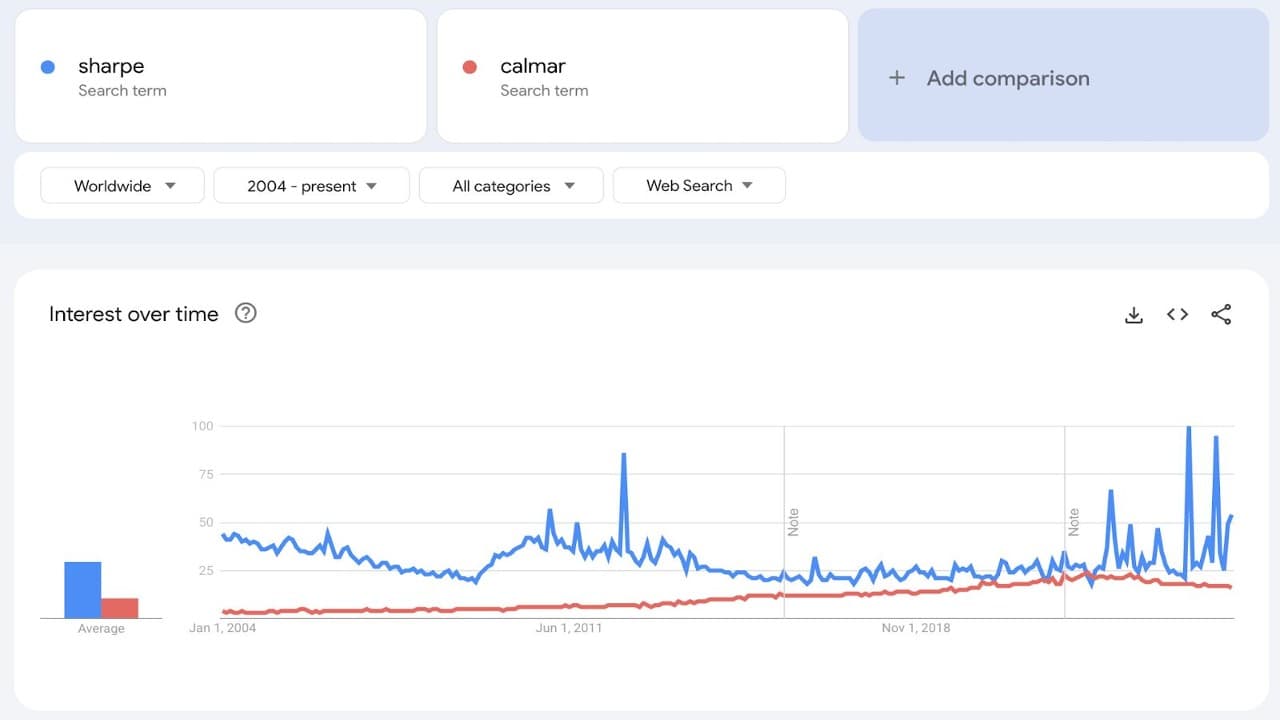
Calmar: the lesser known but far more intuitive brother of Sharpe.
It's better to rely on risk-adjusted returns than just returns. When most people think about risk-adjusted returns they think of the Sharpe ratio which uses volatility as a measure of risk.
Why Calmar matters
Volatility isn't always bad. Drawdowns definitely are! This is where Calmar comes into picture, as it uses Max Drawdown as the measure of risk.
Calmar ratio = Annualized Returns / Max Drawdown
Drawdown is the peak-to-trough drop in percentage terms.
Sharpe focuses on day-to-day fluctuations. Calmar focuses on surviving the worst.
Why Calmar can be more intuitive:
- Calmar tells the investor what returns they can expect per unit of risk capital.
- Drawdowns are easier to interpret than standard deviation of returns.
- It can guide your leverage better.
NOTE: Given Calmar relies on Max Drawdown, there should be sufficient history for an accurate representation of the risk in the strategy.
Benchmarking Quant strategies vs indices
Most equity indices historically provide annualized returns of ~10%, while having a Max Drawdown of 50%.
Equity indices: Calmar ~= 0.2
Good Quant trading strategies: Calmar > 3.
That's much better returns given a particular Max Drawdown. The main goal of Quant Trading is to build a trading strategy that goes up a lot more than it goes down. Due to this, Quant strategies, in principle, deliver superior risk-adjusted returns than buy-and-hold strategies.
Example on leverage
A Quant strategy of 3 Calmar could come from, as an example, generating 9% returns for 3% Max Drawdown.
If you can tolerate 50% Max Drawdown in equities, then even if you leverage the Quant strategy 5x:
- Your Max Drawdown would still be ~15%, a lot lower than the 50% in equities.
- You could generate returns close to ~45%.
This is subject to capacity constraints. Things don't scale linearly closer to strategy capacity.
NOTE: Using leverage can increase the risk of massive losses that wipe out your capital during extreme market conditions. In extreme situations, liquidity can dry up and market correlations can shift, making losses much greater than anticipated. Any leveraged strategy should be thoroughly stress-tested.